
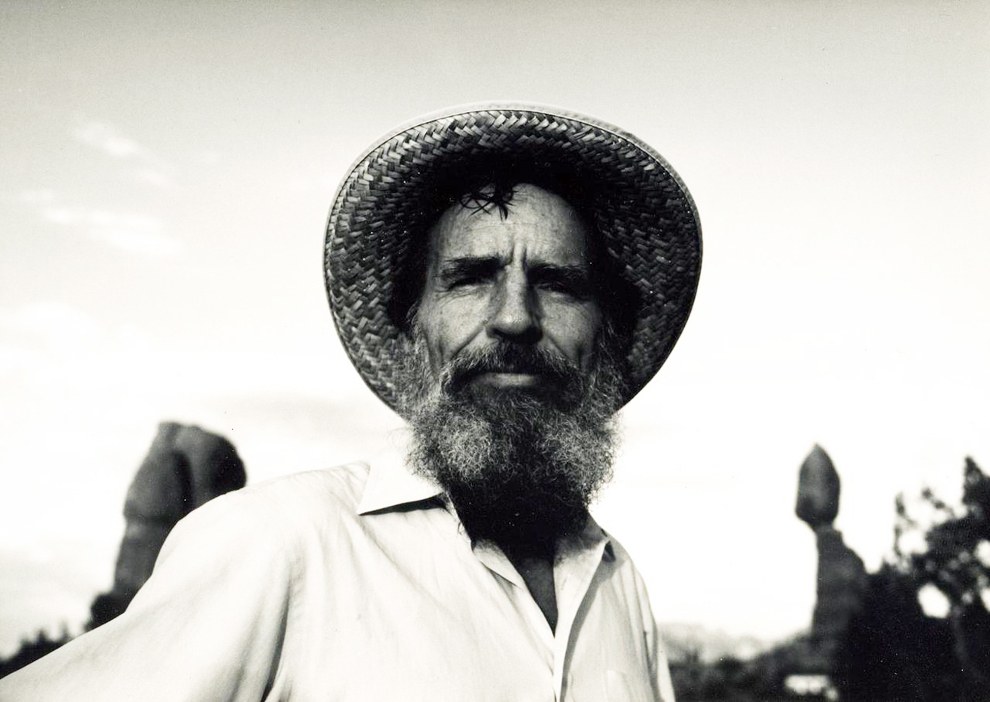
EDWARD ABBEY

(1927 - 1989)
POLITICS ::: ENVIRONMENTALIST :::
Edward Abbey was born on January 29, 1927, in Indiana, Pennsylvania, far from the deserts that would come to define his voice, but perfectly placed to sharpen it. He grew up suspicious of authority, allergic to sentimentality, and deeply attuned to the ways institutions grind people and landscapes into compliance. Abbey served briefly in the military, studied philosophy, and became a ranger for the National Park Service—an experience that did not turn him into a preservationist mascot but into a furious, funny witness. He loved wild places not as scenery but as living systems, and he distrusted anyone who claimed to manage them “for the public good.” From the beginning, Abbey wrote like someone kicking holes in a fence rather than asking for a gate.
That sensibility found its clearest expression in Desert Solitaire (1968), a book that masquerades as nature writing while quietly detonating the genre from within. Abbey rejected the postcard version of the American West, replacing it with heat, boredom, rage, beauty, and moral contradiction. He attacked industrial tourism, dams, roads, and the creeping idea that wilderness only mattered if it could be consumed efficiently. His prose was sharp, profane, lyrical, and intentionally abrasive—less Thoreau in a cabin than a prophet with a hangover. Abbey didn’t ask readers to admire nature; he demanded they stop destroying it.
Abbey’s legacy hardened into myth with The Monkey Wrench Gang (1975), a novel that blurred satire and sabotage so effectively it helped inspire a generation of radical environmentalists. The term “monkeywrenching” entered the cultural bloodstream, and Abbey became a patron saint of eco-resistance—whether he liked it or not. He rejected sainthood, movements, and tidy moral boxes, insisting instead on personal responsibility and direct action. By the time of his death in 1989, Abbey had become something rare: a writer whose ideas escaped the page and entered behavior. In an era of green branding and managed outrage, Edward Abbey still stands as an uncomfortable reminder that loving the land may require disobedience—and that politeness has never saved a wilderness.