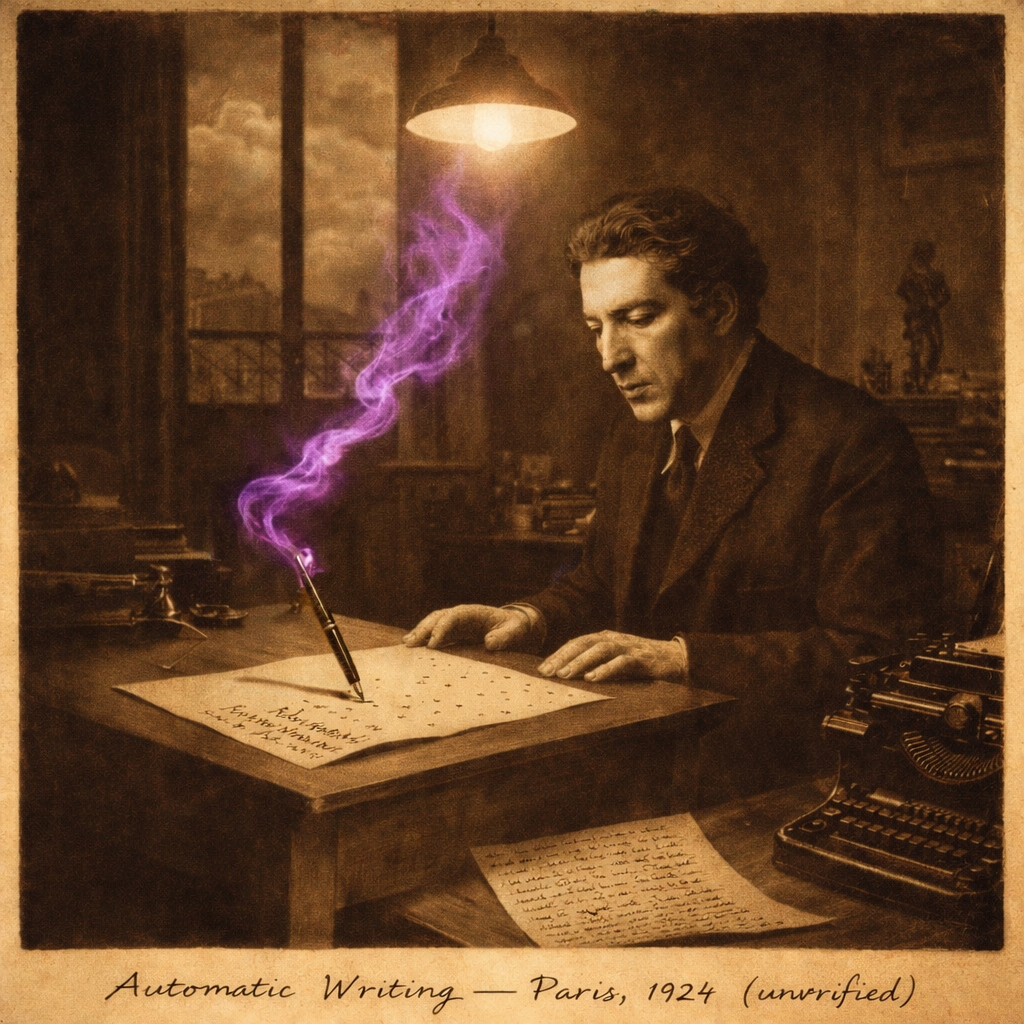
THE 1924 SURREALIST MANIFESTO REIMAGINED (2026)
We no longer live under kings or churches.
We live under dashboards.
The modern citizen wakes to alarms set by machines, works inside invisible architecture, speaks in approved tones, scrolls approved emotions, and falls asleep to blue light. The day is organized, optimized, and flattened. Everything measurable is rewarded; everything human is postponed. We are told this is reality.
We do not accept this definition.
Reality is what happens when the system fails to interpret you — the sudden memory on a bus, the coincidence that rearranges your week, the song that explains your life better than any biography, the dream that feels more factual than your job. These are not glitches. These are transmissions. The unconscious did not disappear; it was simply outvoted.
We therefore declare:
-
The imagination is not an escape from the world.
It is evidence the world is incomplete.
Surrealism is not an art movement but a survival technique. It begins whenever a person refuses to edit their inner life to match polite society. A joke that goes too far, a costume worn in daylight, a poem written instead of a résumé, a photograph taken of the wrong subject, a story told by someone who was never meant to be the narrator — these are acts of liberation.
We oppose the tyranny of usefulness.
A civilization that only values productivity will eventually fear memory, humor, tenderness, idleness, and dreams because none can be quantified. Yet these are the organs of meaning. Without them, a society may function but it cannot live.
We advocate the following practices:
-
Honor coincidence.
Record dreams.
Trust irrational attraction.
Preserve the misfit.
Protect the unnecessary.
Take seriously what amuses you and question what impresses you.
History is not a straight line but a collage. The official record describes what happened; the surreal record explains why it mattered. The people dismissed as strange, obscene, impractical, excessive, or unserious are often the only witnesses to emotional truth. We therefore treat scandal as data and eccentricity as evidence.
We believe beauty appears when categories fail.
We believe humor is a form of intelligence.
We believe contradiction is a sign of life.
The goal is not to abandon reality but to widen it — until waking life and dream life are no longer enemies. When a person can move through the world without suppressing imagination, memory, and desire, the private self and public self reconcile. This state is freedom.
We are not asking for permission.
We are documenting what already exists: a hidden continuity linking poets, outsiders, heretics, revolutionaries, and anyone who has ever felt their real life begin only after the day officially ended.
Reality has been edited long enough.
We now restore the missing footage.
Learn more about André Breton by clicking here.