
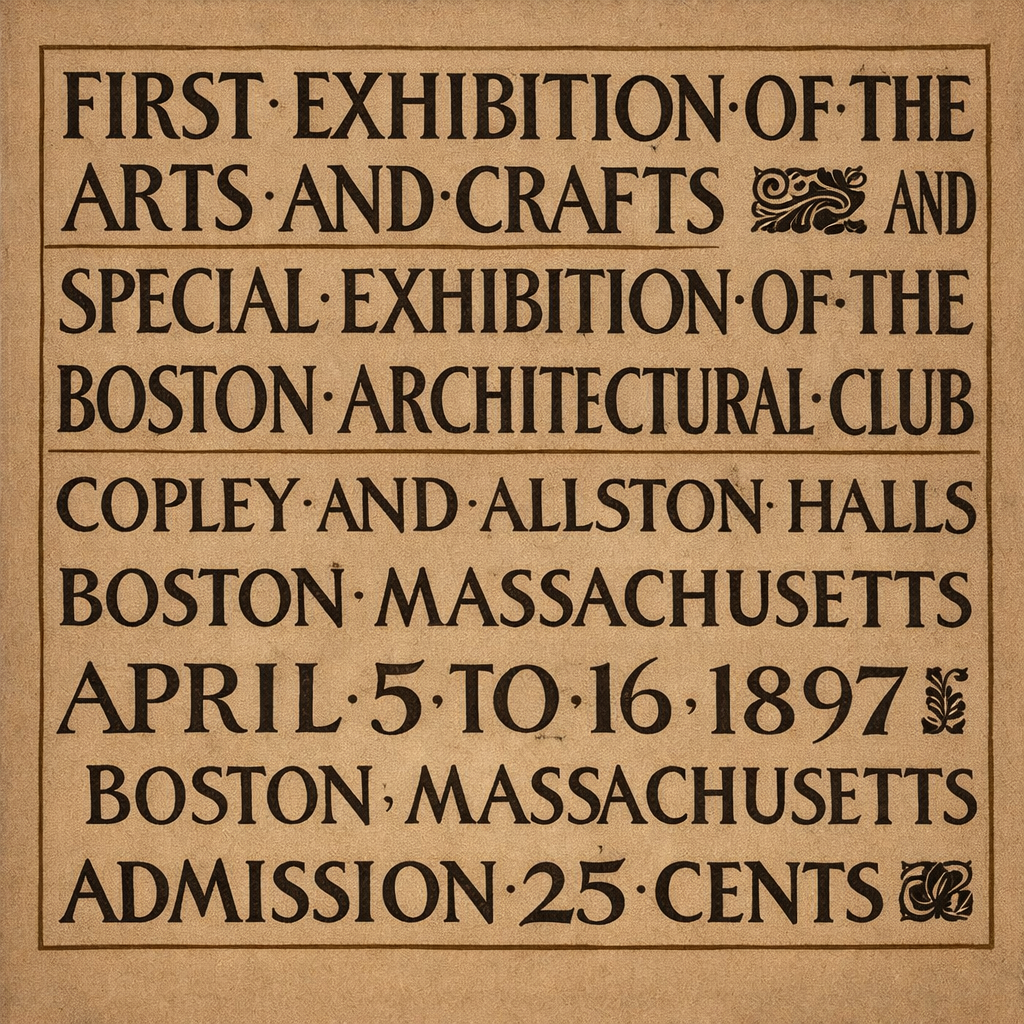
THE 1st AMERICAN ARTS & CRAFTS EXPO

APRIL 5, 1897
BOSTON 400
— At Copley Hall in Boston, the first American Arts and Crafts Exhibition opens as a quiet revolt against the machine age—more than 1,000 handmade objects insisting that beauty, labor, and daily life still belong together. But inside that room, the definition of “craft” is already being stretched. Among the furniture and textiles are photographic prints and finely printed books by F. Holland Day—evidence that this wasn’t just about objects. It was about authorship, intention, and the act of making itself.
Day’s presence changes the terms immediately. Through his Copeland & Day press—modeled after William Morris’s Kelmscott vision—and his staged, symbolic photographs, he pushes the movement beyond wood and metal into image and identity. Craft is no longer confined to the hand; it becomes a way of seeing, a way of composing meaning. The exhibition doesn’t just argue for better things—it argues for a different relationship between creator and creation, where even the self can be shaped like a work of art.
Which means the origin story shifts. Photography doesn’t enter the conversation later—it’s there at the start, embedded in Boston’s founding moment. What will emerge in New York with Alfred Stieglitz and 291 (art gallery) isn’t a beginning but a migration, a change in gravity from craft to modernism. The seed is planted here, in Copley Hall, where the object becomes the image, the image becomes the self, and the future of American art quietly changes course.